Fishing Techniques & Tackle
How we fish and what we fish with. All gear is supplied, but here's what to expect if you bring your own.
Popping
Topwater GT fishing — the most explosive bite in the sea
What is it
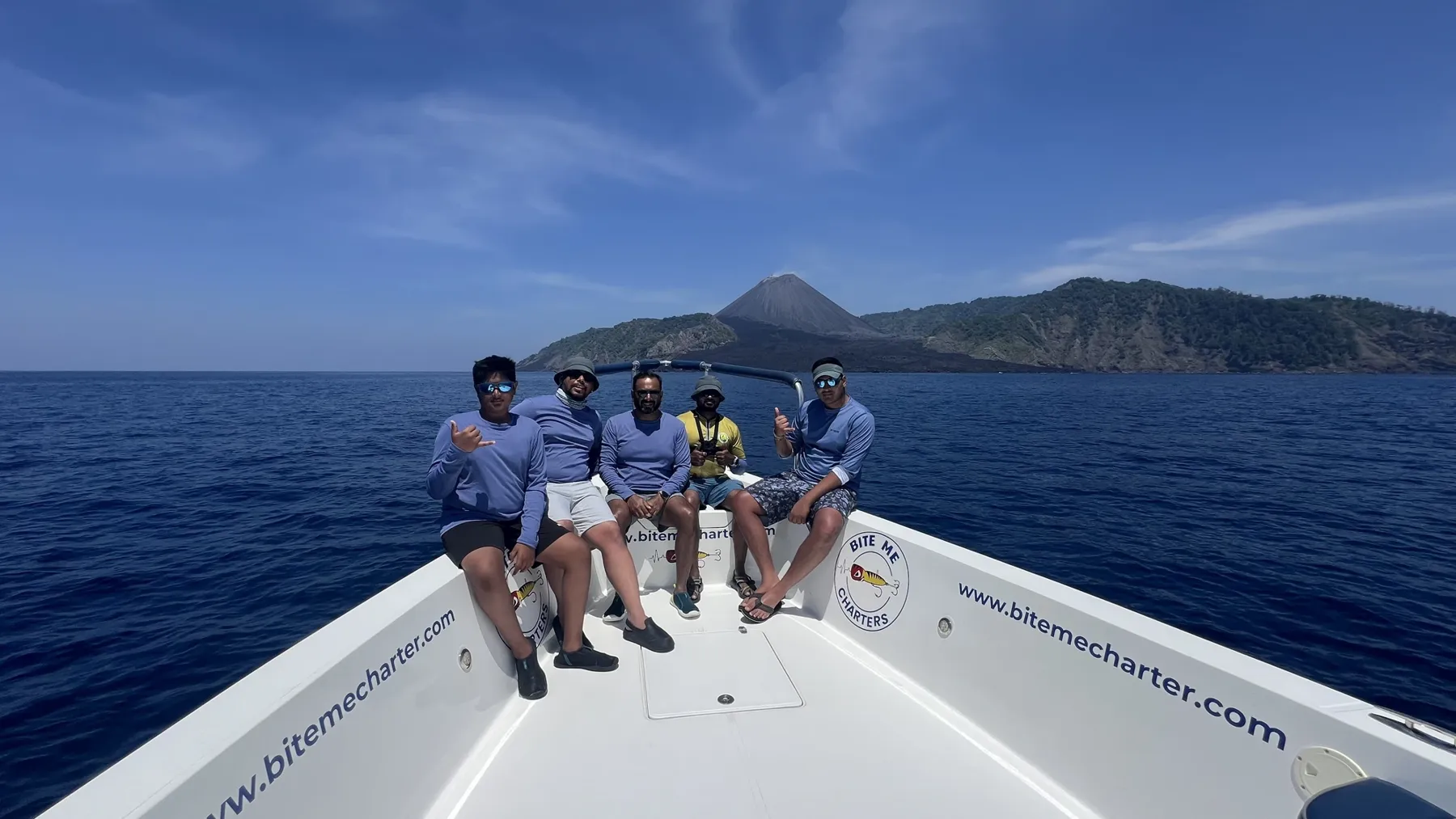
Popping is casting large surface lures — poppers and stickbaits — along reef edges and current lines and working them back with hard sweeps of the rod so they spit, bloop and splash. The target is the giant trevally, though red bass, dogtooth, barracuda and tuna all crash poppers in the Andamans. It is physically demanding, visual fishing with strikes that can lift a 40 kg fish clear of the water.
How we fish it
Cast as far as you can towards the structure, let the popper settle, then drive the rod down and across to make it chug. Pause, wind the slack, repeat. Keep the rod low and the drag locked up — when the fish eats, strike hard twice and hold on; the first run towards the coral decides the fight.
Where
Reef edges, channels, points and drop-offs around Rutland, the Cinque Islands, Little Andaman and the outer banks — anywhere current pushes bait against structure. Best at first light and on the turn of the tide.
Popping Gear Guide
Rod & Reel
02- Rod
- Popping Rod that can handle a drag of 10 kg and over. 7'6" to 8'6" long with the join close to the butt is the perfect tool for the job.
- Reel
- popping needs a high gear ratio (5.0:1 or higher) to collect slack quickly, a drag that exerts 10 kg+ smoothly through repeated runs, and a large spool — minimum 200 m of heavy braid.
Line & Leader
02- Line
- PE8 to PE10 (Jerry Brown, Tuff Line, Power Pro) or braided line of 100 -120 lb breaking strain.
- Leader
- Braid has no stretch and we fish heavy drag, so use 200–300 lb shock leader as a shock absorber, minimum 150 cm. We prefer monofilament over fluorocarbon — softer and more pliable. Fisherman Stealth and Varivas Shock Leader are common choices.
Lures & Baits
02- Poppers
- Carry 12 to 20 poppers between 120 g and 200 g. Bigger, brighter and louder poppers catch the biggest GT. Amegari Urpekari ,Orion, Heru, Hammer Head (E-Cup / G-Cup / Shakure), Craft Bait, Shell Shaping, Halco and Yo-Zuri are familiar models.
- Stickbaits
- When GT won't eat poppers, tempt them with something different — stickbaits that swim just under the surface or sinking models. Good colours resemble baitfish, plus blacks and purples, pinks and redheads. Siren, Shimano, Daiwa, ASWB and Orion are commonly used.
Terminal Tackle
02- Hooks
- No treble is truly GT-proof! Gamakatsu GT Recorder, BKK, Shout, Mustad and Owner all make large GT trebles — use the largest you can find, 6/0 to 10/0 depending on brand.
- Split rings
- Owner Hyper Wire 11H, Shout or Mustad with a breaking strain of 200–300 lb.
Jigging
Vertical metal for dogtooth, grouper and amberjack
What is it
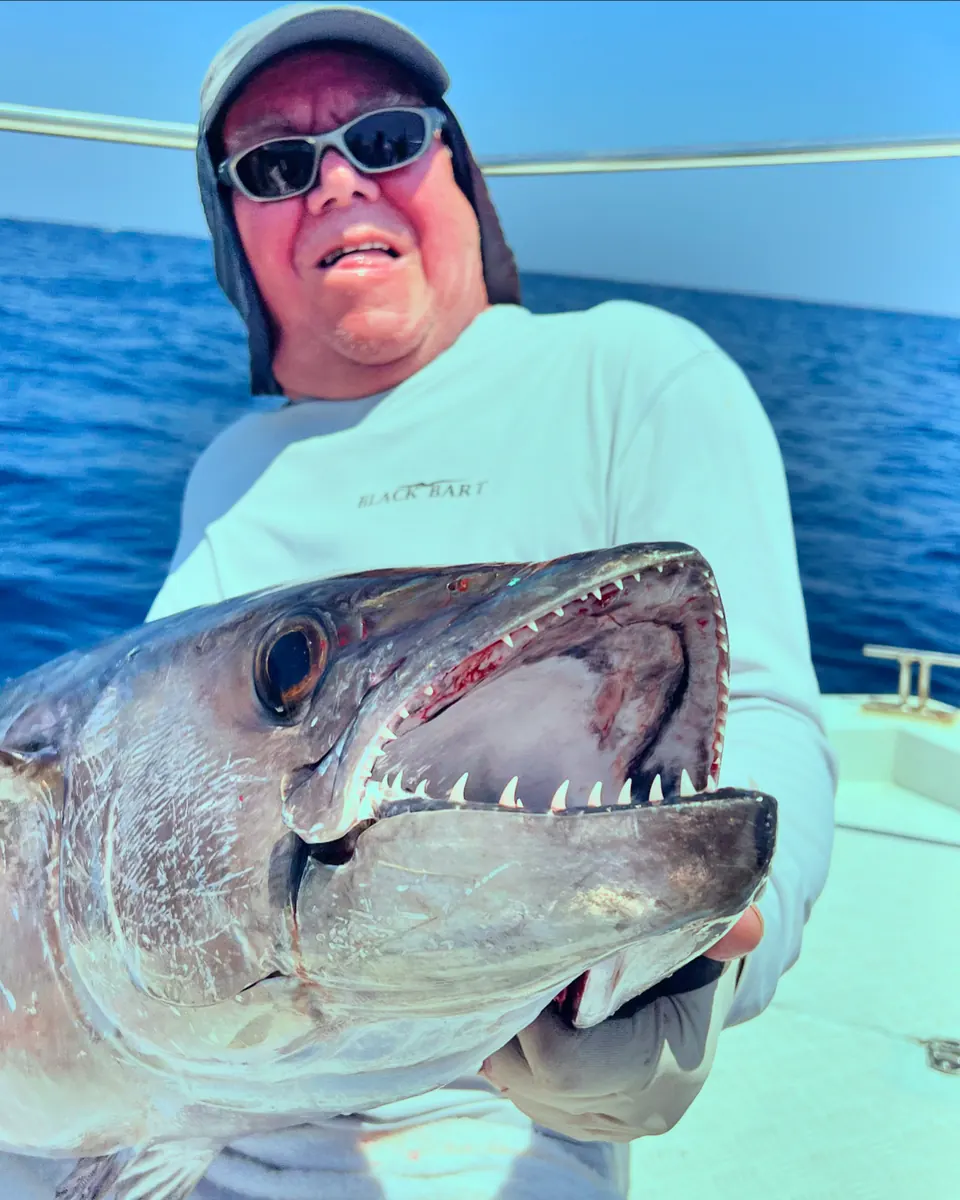
Jigging is dropping a heavy metal lure to the bottom or a chosen depth over pinnacles and drop-offs, then working it back up with rhythmic lifts of the rod and turns of the reel. In the Andamans it produces the biggest dogtooth tuna, grouper, amberjack, jobfish and red bass — fish that live deep and pull hard.
How we fish it
Drop the jig, count the colour changes on the line to know your depth, then lift–wind–drop in a steady rhythm. Vary the speed; dogtooth often hit a fast, erratic jig high in the water while grouper eat it slow near the bottom. Set the hook on any weight and gain line fast before the fish reaches the reef.
Where
Pinnacles, seamounts and steep drop-offs in 50–150 m — Invisible Bank, the Little Andaman banks and the deep edges off Cinque and Rutland.
Jigging Gear Guide
Rod & Reel
02- Rod
- Jigging rods are shorter than popping rods: 5 to 6.5 ft, one or two piece, rated PE4 to PE6 for jig weights of 150–400 g. Jigging depths vary from 50 to 150 m depending on jig weight and current.
- Reel
- Unlike popping, jigging reels need a low gear ratio — easier on the angler and with the grunt to lift hard-fighting fish from the depths. Shimano Stella and Daiwa Saltiga spinning reels work well; for the serious enthusiast nothing beats an overhead jigging reel.
Line & Leader
02- Line
- Thin, no-stretch braid lets you fish deeper with lighter jigs and feel everything. Jigging lines come colour coded so you know your depth — Varivas Avani Big Ones and Daiwa Accudepth are good, easily available brands.
- Leader
- Many anglers jig with fluorocarbon but we prefer mono — its stretch helps when fighting big fish, and it is easier to free from the reef if snagged.
Lures & Baits
01- Jigs
- Carry jigs between 150 g and 350 g. Fisherman Andaman, Skill Jig, JiggingMaster, Shout, Williamson and Duel are popular. We prefer semi-long and long designs in natural, blue/silver, blue/green and pink. Avoid steel traces if you want more bites.
Terminal Tackle
01- Hooks
- Large jigging hooks in sizes 8/0 to 12/0, rigged on Kevlar assist cord — the best being Varivas Assist Line SS 80. Owner SJ-41 13/0, Shout Kudako 7/0 and 9/0, or BKK jigging hooks 9/0 to 12/0 are carried by most jiggers.
Trolling
Covering water for sailfish, marlin, wahoo and tuna
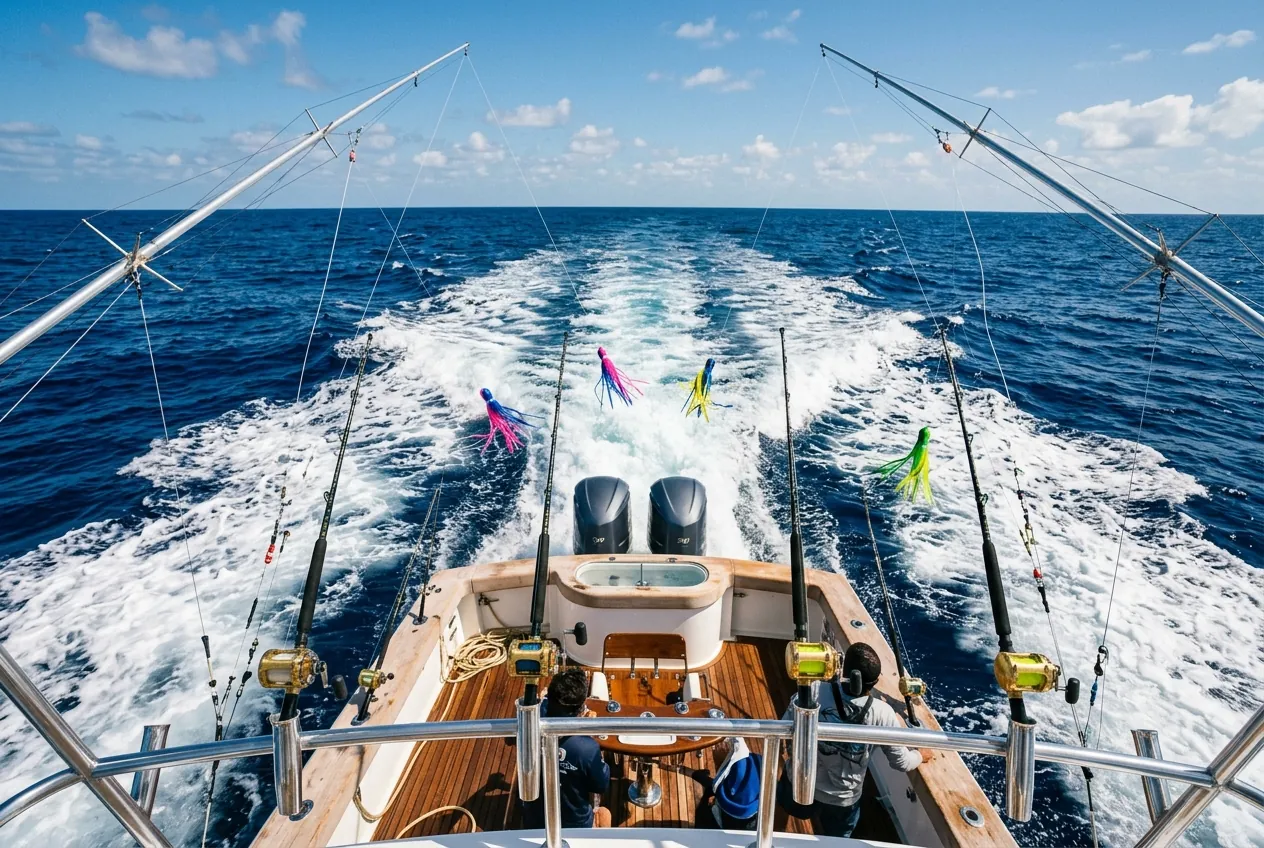
What is it
Trolling is towing a spread of lures or rigged baits behind the moving boat to find pelagic fish in open water. It is how we raise sailfish and marlin, pick up wahoo and Spanish mackerel along the drop-offs and locate tuna schools — and it is the most relaxed way to fish while running between popping and jigging spots.
How we fish it
We run four to six lines at 6–9 knots: skirted lures on the long riggers for billfish, deep-diving bibbed plugs close to the boat for wahoo. When a fish strikes, the angler takes the rod from the holder, keeps steady pressure and lets the skipper work the boat. Billfish are leadered, photographed and released boat-side.
Where
Blue water beyond the drop-offs, current lines, colour changes and bird activity off the southern islands and around Barren Island; wahoo along the steep reef edges.
Trolling Gear Guide
Rod & Reel
02- Rod
- Stand-up trolling rods, 5'6" to 6'6", rated 30–50 lb for sailfish and wahoo and 50–80 lb when marlin are the target. All trolling tackle is supplied onboard.
- Reel
- Lever-drag overhead reels — Shimano Tiagra / Talica 25–50 or Penn International equivalents — holding 500 m+ of line with a smooth, pre-set strike drag.
Line & Leader
02- Line
- 50–80 lb monofilament or hollow-core braid with a mono top-shot for stretch on the strike.
- Leader
- 200–400 lb mono leaders for marlin, 150–200 lb for sailfish; single-strand wire or heavy fluorocarbon traces for toothy wahoo and mackerel.
Lures & Baits
01- Lures
- Skirted lures 8–12 inch in blue/pink, black/purple and lumo for billfish; deep-diving plugs (Rapala X-Rap Magnum, Halco Laser Pro) and bibless minnows for wahoo; rigged ballyhoo when fish are finicky.
Terminal Tackle
01- Hooks
- Strong single J-hooks 8/0–10/0 or circle hooks on bait rigs; all billfish released with circle hooks where possible.
Spinning
Casting lures along the shoreline and reef flats
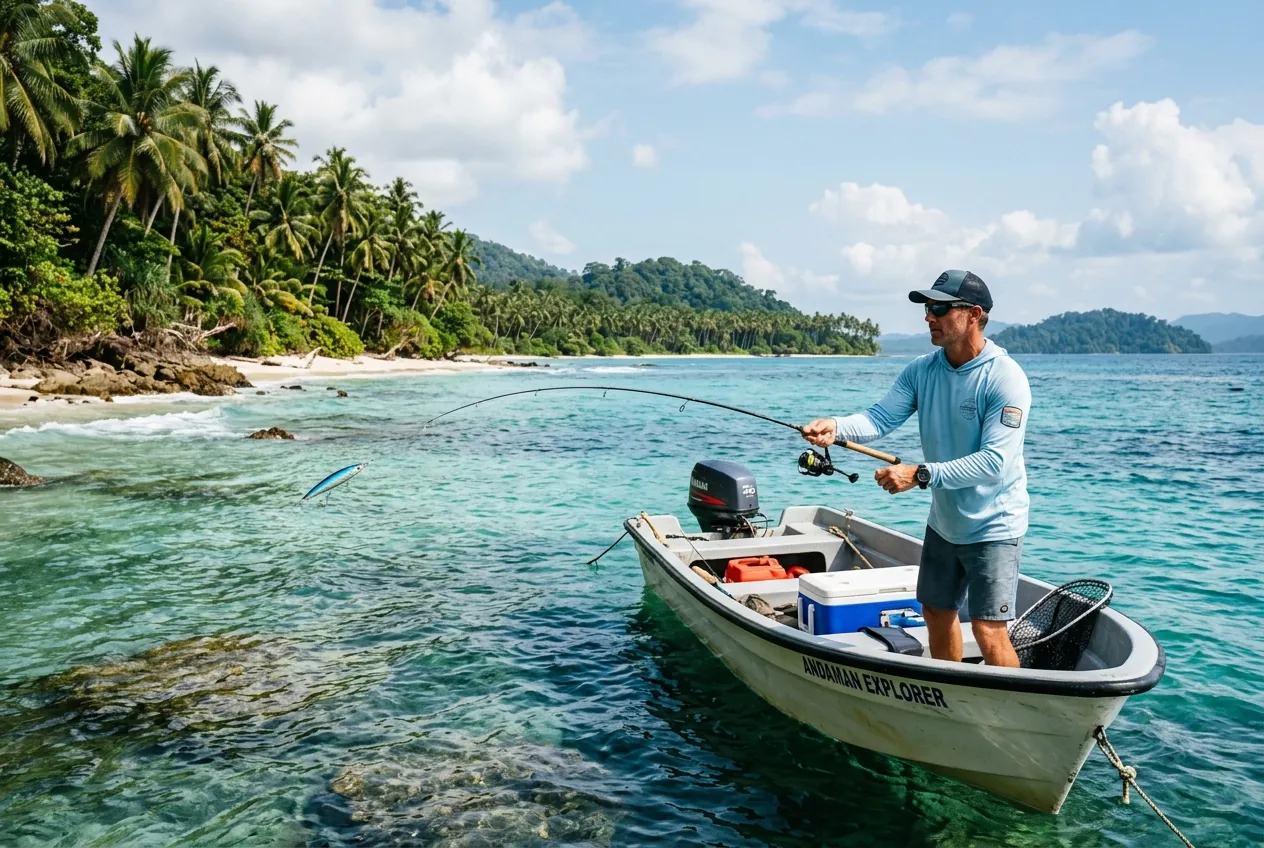
What is it
Lighter than GT popping, spinning means casting medium lures — pencil poppers, bibbed minnows, metal spoons and wedges — at reef edges, bait schools and shorelines for trevally, barracuda, queenfish, Spanish mackerel and tuna. It is fast, fun fishing suited to anglers of all levels and the best way to rack up species.
How we fish it
Work the lure with a steady retrieve and the occasional twitch; speed up when mackerel and tuna are feeding, slow down over the flats for golden trevally. Rigging lures with single or assist hooks instead of trebles makes for safer, cleaner releases and great fishing.
Where
Inshore reefs, island points, lagoon mouths and bait balls around Port Blair, Ross, North Bay and the islands south to Cinque.
Spinning Gear Guide
Rod & Reel
02- Rod
- A rod between 7 and 9 ft rated PE3 to PE5 with the join close to the handle.
- Reel
- Stella, Saltiga or similar in 5000–8000 size with a high rate of retrieve.
Line & Leader
02- Line
- PE3 to PE5 braided line — 60 lb is ideal.
- Leader
- Monofilament 100 to 140 lb.
Lures & Baits
01- Lures
- Pencil poppers, bibbed casting lures, metal spoons and wedges are all good choices. Rigging them with single or assist hooks makes for some great fishing.
Terminal Tackle
01- Hooks
- Inline singles 3/0–6/0 (Owner, BKK, Decoy) or assist hooks on spoons; strong 150 lb split rings.
Light & Micro Jigging
Slow-pitch and micro jigs for inshore reefs
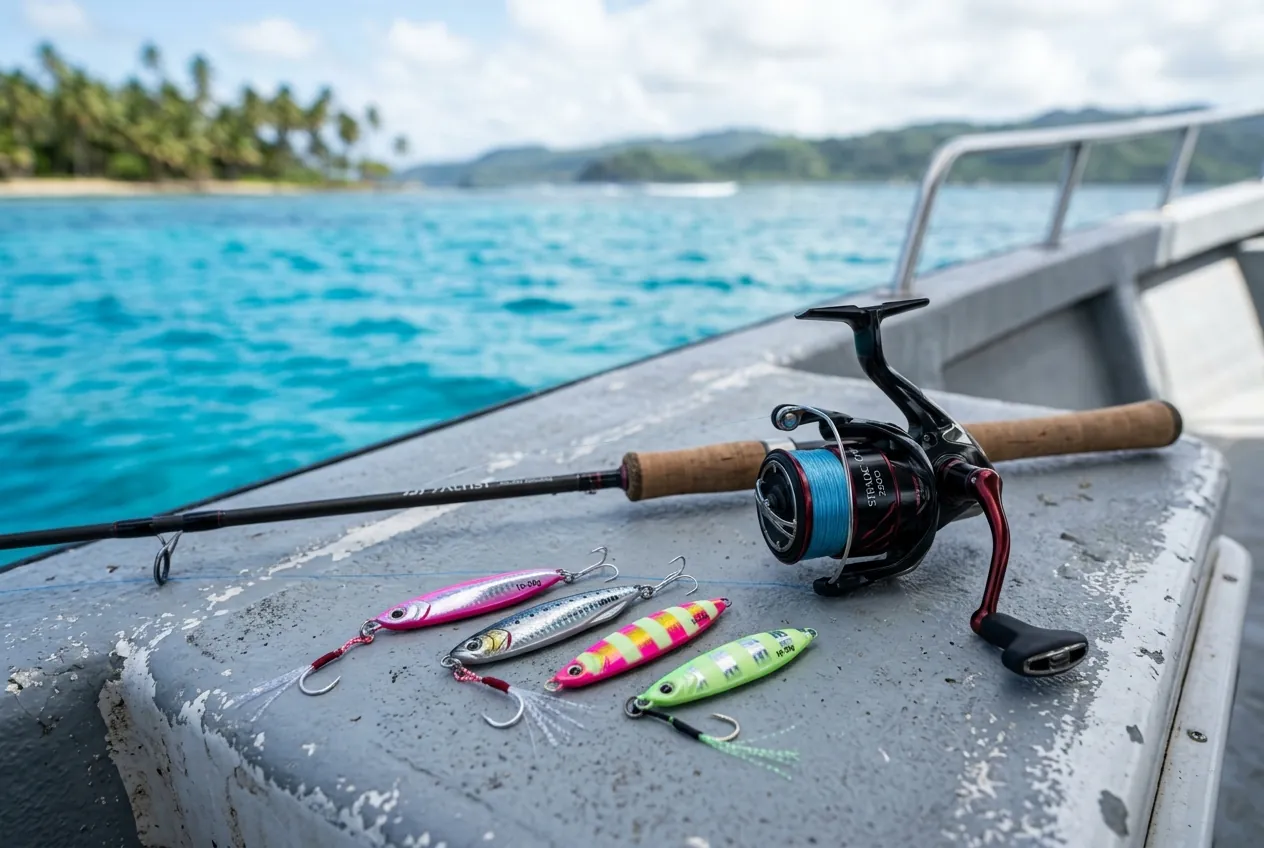
What is it
Light and micro jigging scales the jigging game down — 30–150 g slow-pitch and micro jigs on PE1–PE3 outfits over inshore reefs and shallow pinnacles. The variety is huge: grouper, snapper, jobfish, trevally, emperor and the occasional surprise dogtooth. Perfect for anglers who like finesse, and great sport on calmer days.
How we fish it
Drop to the bottom, then use short, rhythmic lifts of the rod to make the jig flutter and fall — most bites come on the drop. Slow-pitch rods load and unload to do the work for you. Use the lightest jig that holds bottom in the current.
Where
Inshore reefs and pinnacles in 20–60 m around Port Blair, Rutland and the Cinque Islands.
Light & Micro Jigging Gear Guide
Rod & Reel
02- Rod
- Slow-pitch or light jigging rod 6–6.5 ft rated PE1 to PE3 for jigs of 30–150 g.
- Reel
- Small overhead (Shimano Ocea Conquest 300, Daiwa Saltiga 15) or 3000–4000 spinning reel with a smooth drag.
Line & Leader
02- Line
- PE1 to PE2.5 braid, 20–40 lb, colour coded.
- Leader
- 40–60 lb fluorocarbon, 2–3 m.
Lures & Baits
01- Jigs
- Slow-pitch and micro jigs 30–150 g in glow, silver, pink and zebra patterns.
Terminal Tackle
01- Hooks
- Twin assist hooks top and bottom, sizes 1/0–4/0 on fine Kevlar cord.
Fly Fishing
Flats, bluewater and reef edges on the fly
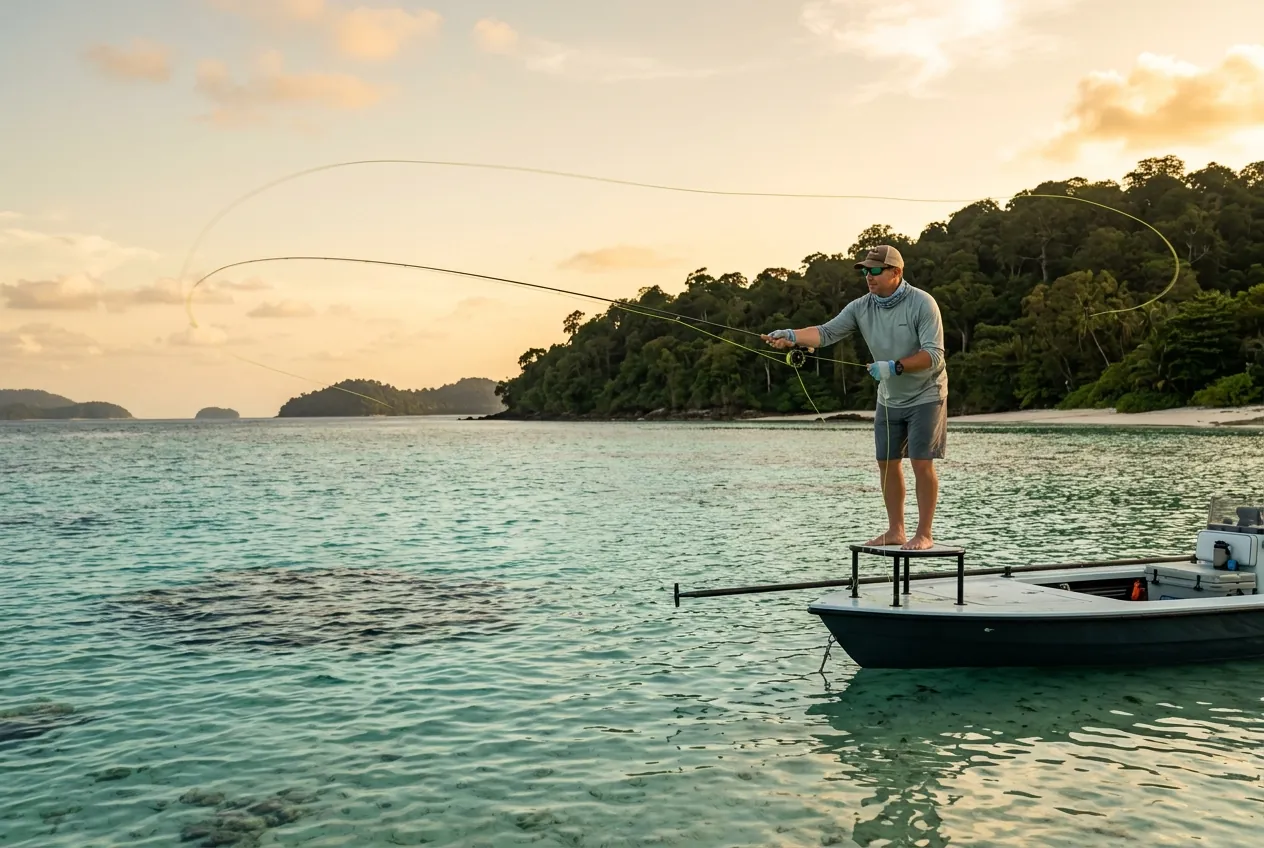
What is it
Saltwater fly fishing in the Andamans ranges from stalking golden trevally, bluefin trevally and garfish on shallow flats and reef edges to teasing GT and sailfish within casting range of the boat. It is the ultimate challenge for the travelling fly angler — and we have the water for it.
How we fish it
On the flats, spot the fish, lead it and strip fast. From the boat we tease fish up with hookless poppers or teasers, then present the fly as the teaser is pulled away. Strip-strike hard and clear the line — a GT on fly is a serious test of knots and nerve.
Where
Shallow flats and lagoons around Havelock, Neil and the southern islands; reef edges and bait schools for bluewater sessions.
Fly Fishing Gear Guide
Rod & Reel
02- Rod
- 9 ft fast-action saltwater fly rods: 9–10 weight for flats species, 12 weight for GT, 12–14 weight for billfish.
- Reel
- Large-arbor sealed-drag saltwater reels with 300 m+ of backing (Hatch, Nautilus, Abel, Tibor).
Line & Leader
02- Line
- Tropical floating and intermediate lines; 400–600 grain sinking heads for reef edges.
- Leader
- Flats: 12–16 ft tapered to 16–20 lb. GT and billfish: short 6–8 ft leaders with 80–130 lb shock tippet.
Terminal Tackle
01- Hooks
- Gamakatsu SL12S / SC15 and Owner Aki in 4/0–8/0 for GT; 1/0–2/0 for flats patterns.
Accessories
01- Flies
- Brush flies, NYAP poppers and large baitfish patterns for GT; Clousers and crab patterns for the flats; big tandem billfish flies.